Wednesday, 18 March 2026

Mar 18: Guest blogger Carl Lee #9: From Goa to John Lewis

The latest in a series of blog posts from Carl Lee. I hope you are enjoying them as much as I am... this one starts on the coast of India back in the late 1980s, when I was just starting my teaching career. 

From Goa to John Lewis

In 1988 I found myself heading south from Mumbai on the night-train to Panaji, the state capital of Goa on the west coast of India. 

Goa had been a Portuguese enclave, once part of the ‘Estado da India’ that also covered trading ports from Gujarat (Diu) to Kerala (Cochin), with roots as far back as the early 16th century. On India gaining independence from the British Empire in 1947 Goa remained a part of Portugal until 1961 when the Indian army invaded and seized control. 

Yet it was not until 1987 that Goa became a full state within India.    

Since the late 1960s, Goa had been an integral part of the over-land hippie trail. 

To some it was the final destination after Kabul, Kashmir and Kathmandu. An under-ground culture of beach-based hedonism developed, fuelled by hashish from the 3Ks. 

I would be disingenuous if I did not admit at this point that such hedonism was part of the attraction of Goa as I headed south on the train, and the fact that it was one of the few places in India you could get a cheap cold beer. 

Christmas was coming and Goa was beckoning.

I stayed for 6 weeks; co-renting an old, falling down, Portuguese colonial house from a nun, with its own well and ‘pig toilet’ (don’t ask). It was under a palm grove on the edge of the village of Vagator, a couple miles north of the ‘legendary’ beach resort of Anjuna with its hippie market and full moon parties. I was looking forward to going to a full-moon party and getting down to some Bob Marley, maybe a bit of soul and funk. What I wasn’t expecting was what I initially disparagingly called Italian electro-disco but later found out was some of the very early roots of acid house music. When was anybody going to put some reggae on? 

Source: https://en.wikipedia.org/wiki/Goa_trance#/media/File:Vagator,_Goa,_India,_Trance_party_in_Goa,_Psychedelic_art.jpg

In the quiet rural Goan nights, finding a party wasn’t difficult - just head towards the thumping beat. And it was that beat, a repetitive four on the floor 120 to 150BPM, which jarred my musical sensibilities. On the beach at Vagator parties kicked off at sunset and rolled on way past sunrise. In such matters I was seriously lightweight - I only knew that they went on post sunrise because they kept me awake, woke me up, or we’d bump into the spaced-out stragglers as we sauntered down to the beach for breakfast.    

The disparate nationalities that were drawn to the Goan beach-party scene at that time were primarily European, a fair number of Australians and a surprisingly large Israeli contingent. Plenty of life’s flotsam; its damaged, its wayward, its idealistic and hedonistic was washing up on those Goan beaches but what they were listening too had legs way beyond the sand. 

The mash-up of electro, house and trance sounds that were being explored by those pioneer Goa DJs proved to be influential on the birth of acid house and its multitude of sub-genres that blossomed in the UK from 1988 onwards. It even spawned its own sub-genre ‘Goa Trance’ which had a particularly strong following in Israel with acts such as Astral Projection, Infected Mushroom and Astrix to the fore. 

Geographer Arun Saldanha’s 2007 book ‘Psychedelic White: Goa Trance and the Viscosity of Race’ ethnographically deconstructs the Goa dance culture through the prism of a materialist theory of race, which Brown University academic Masha Hassan extended with her 2025 analysis entitled “India’s Right-Wing Raves: Hindutva, Zionism and Psychedelic Trance’. 

You can waste an hour or so looking back on these Goan beach parties on You Tube with this one of ‘Goa trance party at Vagator, Goa 1992’ being pretty much as I remember, albeit four years previously. 

Goa trance party at Vagator, Goa 1992

Wild abandon on the dance floor where nobody cared what shapes you were throwing, and tracks that went on and on until they changed and you had not really noticed. Look closely and you’ll see that this is broadly a ‘Western’ event with locals relegated to servicing events: chai, food and taxis.  

The burgeoning dance music scene that exploded across the UK in the late 1980s and early 1990s became a significant cultural game-changer as well as having significant social impacts. It was open, accepting and crossed ethnicities and classes. 

It was not long before dance music escaped its under-ground transgressive vibe; the illegal raves in fields, warehouses, Castlemorton Common, SMS messages and the wave of ecstasy. 

By the early 1990s dance music jumped up everywhere, the charts, in the high street clubs and was cemented in popular culture when Primal Scream’s 1991 album ‘Screamadelica’ won the inaugural 1992 Mercury Music Prize. 

Here's the track 'Movin' on up'.

In 2025 the much-anticipated John Lewis Christmas television ad referenced those heady days of dance music frenzy to a generation now much more grown-up.

A father and his son on Christmas Day, hesitant around each other, make a connection through the gift of Alison Limerick’s 1990 floor-filler of a groove ‘Where Love Lives (Come On In)'. 

A track artfully selected by John Lewis’s ad company for maximum emotional impact. The father drops the needle and is taken back to those hedonistic dance floors of the 1990s when optimism was still in the air. Limerick's track was so explosive at the time blowing up clubs all over the world that early acid house DJ Danny Rampling said of in 1992 ‘that it will still sound good in 20 years’, and he is not wrong. 

Hear it for yourself with the classic club mix. 

It’s a bit more melodic than the squelchy beats and bleeps of the early Goa raves but its connection with them is clear. 

From spaced-out raver to ‘centrist dad’. It’s a journey many have probably made. 

References and reading.

“India’s Right-Wing Raves: Hindutva, Zionism and Psychedelic Trance’.

‘Psychedelic White: Goa Trance and the Viscosity of Race’ 

Carl Lee is retired but was a lecturer at The University of Sheffield and Sheffield Hallam University, taught A level Geography for 20 years at Sheffield College, is the author of five books about geography and has a PhD in economic geography. He has been nuts about music since buying his first single in 1973: 10cc’s 'Rubber Bullets' if you were wondering.

Tuesday, 17 March 2026

Mar 17: Every Valley - Public Service Broadcasting

Every Valley is an album by Public Service Broadcasting who I have mentioned elsewhere on the blog. I shall also return to this at a later date.

It tells the story of the growth and decline of the coal mining industry (in South Wales in particular) and is an excellent piece of work.

Like all their music it blends electronic music and some cracking guitar work and drumming with electronics.

It was recorded in Wales and the band actually moved into a village hall in Wales and built a recording studio.

Here's a making of documentary which shows some of the ways that the sense of place of the village where they were based influenced the work.


And a track by track...


This way of working is something that Public Service Broadcasting have done for some albums. For their Berlin album, J Willgoose moved to Berlin.

This connection with place is one of the reasons I like the band so much.


During this expedition through its massive archives, Public Service Broadcasting delved into material outlining the acme and descent of coal mining in the Welsh countryside but J. Willgoose Esq. didn’t stop there. Noting the extensive list of informative records and expert individuals tapped for research insight (The National Coal Board films at The BFI, independent documentary, “The Welsh Miner,” and audio tape from the South Wales Miners’ Library at Swansea University) and even interviews fostered by J. Willgoose Esq. himself and recorded on the album (as is the case for the secretary and caretaker of the local branch of the National Union of Mineworkers), the labour intense footwork required for the conceptual foundation of Every Valley makes the record feel more like a doctorate research paper that happens to have original music behind it, than vice versa.

Mar 17: Solo albums #1: Fly by Night

What do you think have been the best solo albums which have been produced by someone who spent a long time in a band first?

Feel free to tell me in the comments below.

In November 1983,  I was watching Pebble Mill at One in a student house in Huddersfield - I was probably supposed to be writing an essay on the Atterberg limits - and was probably eating toast made on the gas fire - and this came on. Ian Anderson of Jethro Tull being interviewed, and a film about his life on the Isle of Skye, which I'd visited several times already to climb in the Cuillins.

Thanks to YouTube you can watch it here.


In the film, we see Ian Anderson talking about his life on the Isle of Skye at the time, living on the Strathaird Estate.

He released his first solo album 'Walk into Light' at the end of 1983. I liked the design of this album very much and bought it on vinyl on release (as was the case for most of the albums I owned of course until CDs began to usurp them - temporarily it turns out).
The album cover looked like a TV test card.


There are some really good tracks on this album, and I saw some of them performed during the mid 1980s at Jethro Tull gigs where they were added to the set. 

Here's 'Fly by Night' being performed during the 1984 'Under Wraps' tour, which I saw several times in different venues, including the Hammersmith Apollo (as was) - a show that was recorded for a later LP release.


Mar 17: Wall-E

A great geographically related song from the end credits of WALL-E: "Down to Earth".

Wall-E's theme is about the despoilation of the earth by consumerism, led by the BnL corporation.
This is short for Buy 'n' Large.

When I saw this film when it first came out I hadn't heard of Peter Gabriel's involvement with the music. It was only as the credits rolled and the song started that I heard his distinctive voice and knew it must be by him... 


From the Archived Buy N Large website which went along with the film on its release.

However, by the year 2057, as shown on the Buy n Large website, the conglomerate became a worldwide leader in the fields of aerospace, agriculture, construction, consumer goods, corporate grooming, earth transport, electronics, energy, engineering, finance, food services, fusion research, government, hydro-power, infrastructures, inventions, media, medical science, mortgage loans, pet care, pharmaceuticals, psychotherapies, ports and harbors, real estate, repairs, retail, robotics, science/health, space, storage, super centers, super grids, travel services, utilities, and watermills. The corporation's control affected other companies as well. It seemed as though other businesses wanted BnL to buy them out, such as Headr Inc. which gave BnL control of the world news headlines.

And finally another beautiful track from WALL-E with Peter Gabriel's touch on it, along with Thomas Newman: 'Define Dancing'.


One of Pixar's best from the era when they made must-see films... my son has a Criterion 4K edition with beautiful packaging and fantastic picture quality....

What other songs from Pixar films do you really like?

Let me know in the Comments below.

Monday, 16 March 2026

Mar 16: Anthems #2: Mr. Brightside

Another song I've heard played live, and one which has apparently stayed in the charts for years.

Here's the song... you know the lyrics...


The Killers are a band which has built a huge following. They played a memorable Glastonbury set which I remember well.
Brandon Flowers has also produced some interesting solo work.

I used their track 'Human' as the music for a presentation back in the day when I was driving round the country working for the Geographical Association.

Mar 16: There will come a time

This came into my feed a while back. It's a Brian Cox narrated track from Orbital. It's a bit spacey...

Mar 16: Pink Floyd in Venice

Pink Floyd's concert in Venice. was an interesting moment in music history and one which also links with the history of the city and its complex issues. 

The band had been trying to play in the city for some time but could not get permission for fears of the damage it may cause to the city.

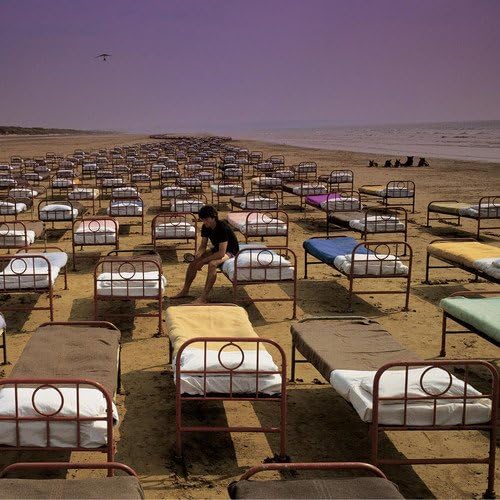
In 1987, the band released their album "A Momentary Lapse of Reason".

The band toured the album around the world. I attended the tour when it reached Manchester, with a concert in the old Maine Road stadium which was home to Manchester City at the time. It took place on the 8th of the 8th, 1988 (and the concert started at 8 minutes past 8. More on that in August.
Here's the setlist that I saw: https://www.setlist.fm/setlist/pink-floyd/1988/maine-road-manchester-england-3bd76478.html

I've previously shared the story of the album cover's creation.
Momentary Lapse of Reason

There were real concerns over the possible environmental impact of the concert on the ancient city itself.

The free concert was held in St. Mark's Square in Venice. This was to be a free concert so people travelled in various ways to be there.

The concert is shown periodically on Sky Arts on Freeview.

Local Italian news media were not impressed...

Despite local protests, they were allowed to play a free concert from a barge in the lagoon opposite St. Marks square, from where an estimated 200.000 people watched this concert. The concert was nearly cancelled on July 13th when the City's Superintendent of Monuments claimed that the vibration could damage buildings. 

To pacify critics Pink Floyd played a reduced volume, but there were still claims of damage to marble cladding after the concert. 

Lamp-posts were also broken by fans climbing them for a better view. The city authorities failed to provide facilities for the visiting fans, many of whom slept in St. Marks square. They left behind them 300 tons of litter, which had to be cleared by the Army. After a seven-hours sitting, the council apologized to Venice residents for the inconvenience, promising that no similar concert wouild ever be allowed. Therefore, this concert can be placed in the books as UNIQUE. The alderman in charge of Venice's Culture Committee, Mr. Silvan Ceccarelli, resigned, explaining: "I feel that I have to go, because I'm one of the people who gave the go-ahead for this concert." 

Despite initially refusing to do like wise, the rest of the council went soon after, leaving the city in the hands of an ad-hoc administration. 

Over 100 million viewers in 23 countries saw the show on TV.


Tradition vs modernity was at play here.

Pink Floyd also famously played at Pompeii, and the movie of that concert recently had the 4K treatment and a re-release. It's a memorable concert with the band looking remarkably young.

Sunday, 15 March 2026

Mar 15: Nick Drake and Mackenzie Crook

In December 2024, I went to the Cambridge Union to see an event that had been arranged as part of the Cambridge Literary Festival. The city was full of Christmas shoppers. I hadn't been to the Cambridge Union before.

The event was a discussion with Mackenzie Crook.

Mackenzie has written and illustrated a short book - not a children's book - an interesting format really - imagining Nick Drake coming to his house, and modelled on a book he remembered from his childhood.


Drake signed to Island Records at twenty while still a student at Fitzwilliam College, Cambridge University. Marking the 50th anniversary of his death, the book is both a celebration of his memory and a heart-warming reminder of the impact a person can have on others, though they might not realise it.

There was lots of interest in the detectorists of course, as not everyone was familiar with the music of Nick Drake.

He was in conversation with Tom Gatti, the executive editor of the New Statesman magazine.

He mentioned a Q and A that Mackenzie had done for the New Statesman magazine in the latest issue.

During the talk, when asked about the detectorists, he mentioned a book that had been written by 'some university professors' - called 'Landscapes of Detectorists' which had a series of essays. 

The book is one I've got of course. 

It grew out of a session at a previous RGS-IBG Annual conference and I reviewed it here.

The book has also recently gone into its third reprint.

Here's a Nick Drake song for you.... the geographically-minded 'River Man'.


What's your favourite Nick Drake track? 

During the interview Mackenzie said that he had been working on a new show about a man who grows magical creatures in his shed. We now know what he was referring to: the wonderful Small Prophets.


Let me know your favourite Nick Drake song in the comments below....

Saturday, 14 March 2026

Mar 14: Francis Dunnery's 'Tales of the Council House Kid'

Francis Dunnery's new album is a reflection on growing up in a council house.

He was born on Christmas Day in 1962 which makes him just over a year older than me.

I'm going to be blogging about his time in It Bites - one of the best bands I saw playing live - which I did a great deal, and sharing more memories of Frank...

Sample tracks on Bandcamp.


This is the stand out one for me, as I can also remember all of those things... and I had a Chopper..

Mar 14: Taylor Swift's ERAS tour

In 2025, Taylor Swift brought her record-breaking ERAS tour to an end, having visited most of the world - with a few large geographical exceptions.... you can perhaps guess which they were.

 The ERAS tour visited the UK, and there's plenty of geography to be had in exploring the economic and environmental impact of the tour and associated music as well as the interesting cultural implications of the event: the demographics of a typical crowd etc. 

The tour was said to have a major impact on an entire country's economy when it comes into town.

Liverpool rebranded itself as Taylor Town.

The University of Liverpool hosted Tay Day, which was described as a "symposium for fans, students and academics to engage with the cultural phenomenon that is Taylor Swift".


Here's a resource I created at the time, and which may still be of interest...
Accept cookies to view...


There were some other stories that made it into the news as well, including a perceived issue with homeless people in Edinburgh.

Now the tour is over, the legacy is worth exploring perhaps.

What will be the next big tour?

Friday, 13 March 2026

Mar 13: 'The Camera Eye' - Rush

If we are talking about cities - as we have been, then I have always returned to the song 'The Camera Eye' by Rush. It comes from their best album 'Moving Pictures'.

Here's the back of the LP cover.

The song moves between London and New York; two cities known to lyricist Neil Peart.

Here's the performance of the song from the Time Machine Tour - the last time I saw them playing live.


The lyrics and the structure of the song are very well crafted. I also love the music, plenty of Oberheim and bass pedals...

This podcast suggest some of the meanings behind the song - the longest one they had recorded for a while and the last time they recorded a song that long.

Neil had read the work of John Dos Pasos, in particular his “USA Trilogy”. And in those books, Dos Pasos uses a literary device he calls “the camera eye”. That’s where Neil got the title from. One of the books in the USA trilogy is called “The Big Money”. Neil would later write a song based on that, too.

“The Camera Eye” opens with the sound of a city. It’s a city street scene. According to Geddy Lee, when they were putting together that pastiche of sound effects, one of the clips they used was a bit of audio from “Superman”, the 1978 movie with Christopher Reeve.

We start in New York:

“Grim faced and forbidding, their faces closed tight.

An angular mass of New Yorkers

pacing in rhythm race the oncoming night

they chase through the streets of Manhattan.”


And then comes the rain that will connect the two cities together.

In London:

“Pavements may teem with intense energy,

but the city is calm in this violent sea.”

Thursday, 12 March 2026

Mar 12: Trivia Quiz Question #6

Which rock band, still going after over 50 years, recorded their first album here, on Denmark Street, near Tottenham Court Road?

Answers in the comments...


If it helps with a clue, here's what Rough Trade Records said when they opened their store opposite in October 2024...

Denmark Street is often described as the birthplace of the British music industry where iconic artists such as Elton John, Sex Pistols and David Bowie hung out, made music and lived. 

I've missed out the answer from the text above.

As part of the wider immersive arts and culture district Outernet London, Denmark St has been preserved and enhanced with new music businesses continuing to open. 

Close by is the 2,000-capacity live venue HERE at Outernet, the largest venue in central London since the 1940s, as well two smaller venues aimed at emerging artists including The Lower Third, named in honour of David Bowie’s early band.

Mar 12: Little Fluffy Clouds

A classic from 'The Orb'.... from 1990.... not that we had those today, and wind is currently roaring around the house and down the chimney...


"They went on forever — They — When I w— We lived in Arizona, and the skies always had little fluffy clouds in 'em, and, uh... they were long... and clear and... there were lots of stars at night. And, uh, when it would rain, it would all turn — it— They were beautiful, the most beautiful skies as a matter of fact. 
Um, the sunsets were purple and red and yellow and on fire, and the clouds would catch the colours everywhere. That's uh, neat 'cause I used to look at them all the time, when I was little. You don't see that. You might still see them in the desert."

Wednesday, 11 March 2026

Mar 11: UNESCO Cities of Music Network

UNESCO has designated a number of cities as Cities of Music.


Find out more about each city and why it was designated.

We will be visiting some of these cities as the blog develops.

What city do you think has the most interesting musical legacy?

Tuesday, 10 March 2026

Mar 10: Guest blogger Carl Lee #8: Walking to Knebworth

The latest of Carl Lee's guest blog posts describes his decision to walk to see the biggest rock band in the world - and just as well that he did...

Walking to Knebworth

In August 1979, Led Zeppelin, who at that time were arguably the largest rock band in the world, played two huge outdoor shows in the parkland of Knebworth House just south of the Hertfordshire new town of Stevenage. It was the first outdoor ‘festival’ gig that I had attended and I walked there.

Back in the sixth-form in the late 70s and early 80s, musical tribes vied with each other for perceived gradations of ‘cool’ but strangely Zeppelin were able to cross these clearly demarcated boundaries. I was more likely to be listening to the Clash or Ian Dury at the time, and Zeppelin’s last album, ‘In Through The Out Door’ was clearly their most ‘meh’ album to date. 

Yet Zeppelin had not played live in Britain for four years and there was clearly a sense of ‘event’. 

If we didn’t go because my musical tastes were evolving from Radio Caroline classic rock to something more edgy and contemporary that really would not be smart. Saturday jobs were enabling of the seemingly affordable £7.50 ticket price: an absolute snip by today’s stratospheric standards of festival tickets. The question was how to get there. 

I’m not sure whose idea it was but being early August and with no school the summer holidays stretching out ahead of us and it was decided that we’d walk there from Leighton Buzzard, where we lived, a distance of some 28 miles. 

So on 2nd August we set off trudging the roads, crossing the A5 and M1 before alighting at Sharpenhoe Clappers, a chalk escarpment a few miles north of suburban Luton. We set up camp just as the sun was setting to avoid detection from outraged locals and did foolish teenage things. 

Drone footage of the Sharpenhoe Clappers

In the morning we set off to complete the 12 miles to Knebworth. This was a more rural route taking us through the villages of Lilley, Kings Walden and St Paul’s Walden before attempting to find the entrance onto the site. To say we were excited would be a huge under-statement although the chaos of the camping area was a shock. Drop latrines, rubbish everywhere, menacing rockers chuntering ‘acid, acid, acid’, hardly any food and already the real hardcore staking out their pitch close to the stage. And this was just Friday night.

Saturday broke and to be honest I don’t have many clear recollections of the rest of the day apart from the fact we were a long way back behind folk much taller than us and with the wind swirling the sound around. 

The only support act that stuck in my mind was Todd Rundgren’s Utopia and that was possibly because of the impossibly tight spandex trousers he was wearing. 

Check out the track 'Singring and the Glass Guitar'....

When night fell and Zeppelin came on stage the excitement was electric. 

I have had to go back and watch a film of the gig to reconfirm my impression at the time:that this was a rather uncertain show, rambling and lacking sharpness. 

And also, because of the distance from the stage and the wind taking the sound away, it was not exactly the greatest aural experience - but hey it was Led Zeppelin playing live! 

It was almost like touching a holy relic, a band of mythical proportions whose music along with Pink Floyd were my first teenage crush. That was probably enough. I bought a sweatshirt from the gig. Somebody’s parents picked us up the next day, bedraggled, in need of a bath, hung-over but with a cracking yarn for the sixth form common room. 

Interestingly, looking back over Wikipedia some comments from the music journalist Chris Welch caught my eye. Attending the show he observed that 

“Audience reaction at Knebworth had not been overwhelming and many seemed content to stand and stare like mesmerised spectators at an alien ritual.” 

Having now been to outdoor shows where the audience has been in raptures and the act or band has been absolutely flying I can completely concur with Welch’s observations. It may have been Led Zeppelins biggest gig but it certainly was not their finest. Yet at the time it was a magical adventure, and it was made much better by walking there. 

It was a sort of pilgrimage. 

Here's another review as well:

And a recording of one of the concerts.

Led Zeppelin: 4th August 1979


Carl Lee is retired but was a lecturer at The University of Sheffield and Sheffield Hallam University, taught A level Geography for 20 years at Sheffield College, is the author of five books about geography and has a PhD in economic geography. He has been nuts about music since buying his first single in 1973: 10cc’s 'Rubber Bullets' if you were wondering.

Additional comments from me:

I remember the different groups when I was in Sixth Form - 1980-1982. I was definitely in the prog-rock camp.

In an interview he gave in 2005, Robert Plant said:

"I was racked with nerves. It was our first British gig in four years and we could have gone back to the Queen's Head pub. We talked about doing something like that. But instead we went back in such a flurry and a fluster to 210,000 people in a field and 180,000 more the next day, surrounded by Keith and Ronnie and Todd Rundgren. Nobody's big enough to meet those expectations. But because there was some chemical charge in the air, it worked. It didn't work for us. We played too fast and we played too slow and it was like trying to land a plane with one engine. But it was fantastic for those who were there."

Here's the official programme - just 90p. Lots of other things archived on this page.


And here's Kashmir to finish:

Monday, 9 March 2026

Mar 9: Anthems #1: One day like this

These are songs which will always get people singing when they come on the radio or at discos, they'll be whistled by people in charity shops, and certainly result in a lot of waving and iPhone torches at concerts when they are played. They're anthems...

Here's the first of some suggestions for anthemic songs... the ones which perhaps bring concerts by the band who created them to a close for years... the ones that the set list builds up to.

I was fortunate to hear Elbow play this live at the end of a concert in Thetford Forest in Norfolk. 

It was a warm and pleasant evening and the crowd was in the arena set in the forest... 

Here's Guy Garvey explaining the meaning behind the song.


Do you have other suggestions?

And don't worry, I have Mr. Brightside already on the list...

Update

Found my ticket from that Elbow gig...

Mar 9: Psycho Killer at 50

A new video for the classic Talking Heads track 'Psycho Killer' was released late last year.


This was played by David Byrne at his live shows on the current tour which I was privileged to see at the Hammersmith Apollo.

This is also the 150th post on the blog.

Sunday, 8 March 2026

Mar 8: HELP(2)

This is the second release from War Child Records.

Help(2) (stylised in all caps) is a charity compilation album created by the organisation War Child in order to raise funds for their work involving helping children living through war. 


It was released on 6 March 2026 through War Child Records.

The album will accompany a documentary film directed by Jonathan Glazer.

The first one was the subject of some work from John Wilkinson and a GA Conference session which was one of the influences on the creation of the blog.

The stand out track for me is Depeche Mode's 'Universal Soldier'.


“Universal Soldier” is an anti-war protest song written by singer-songwriter Buffy Sainte-Marie, who is best known for the Academy Award-winning song “Up Where We Belong” from the film An Officer and a Gentleman. She wrote “Universal Soldier” in 1963 after encountering injured American troops returning home from the Vietnam War. The song has been previously covered many times, notably by Donovan, Glen Campbell, and First Aid Kit.

The album arrives the same week the United States and Israel launched a needless war against Iran, escalating tensions and sowing chaos across the Middle East.

Dave Gahan and Martin Gore have transformed this folk song into a dark, electrified menace. 

Their version bristles with rattling chains, chilling synth pads, and a heavy, deliberate beat, anchored by Gahan’s unmistakable voice. The band recorded the song at Abbey Road Studios in November 2025, which in itself feels notable. 

After the release of Memento Mori and the heartbreaking loss of founding member Andy Fletcher, it wasn’t entirely clear if Depeche Mode would continue recording new material.

The album ends with Olivia Rodrigo doing a cover of Stephin Merritt's 'The Book of Love' - also covered by Peter Gabriel on his 'Scratch my Back' album... a much better version in my opinion.